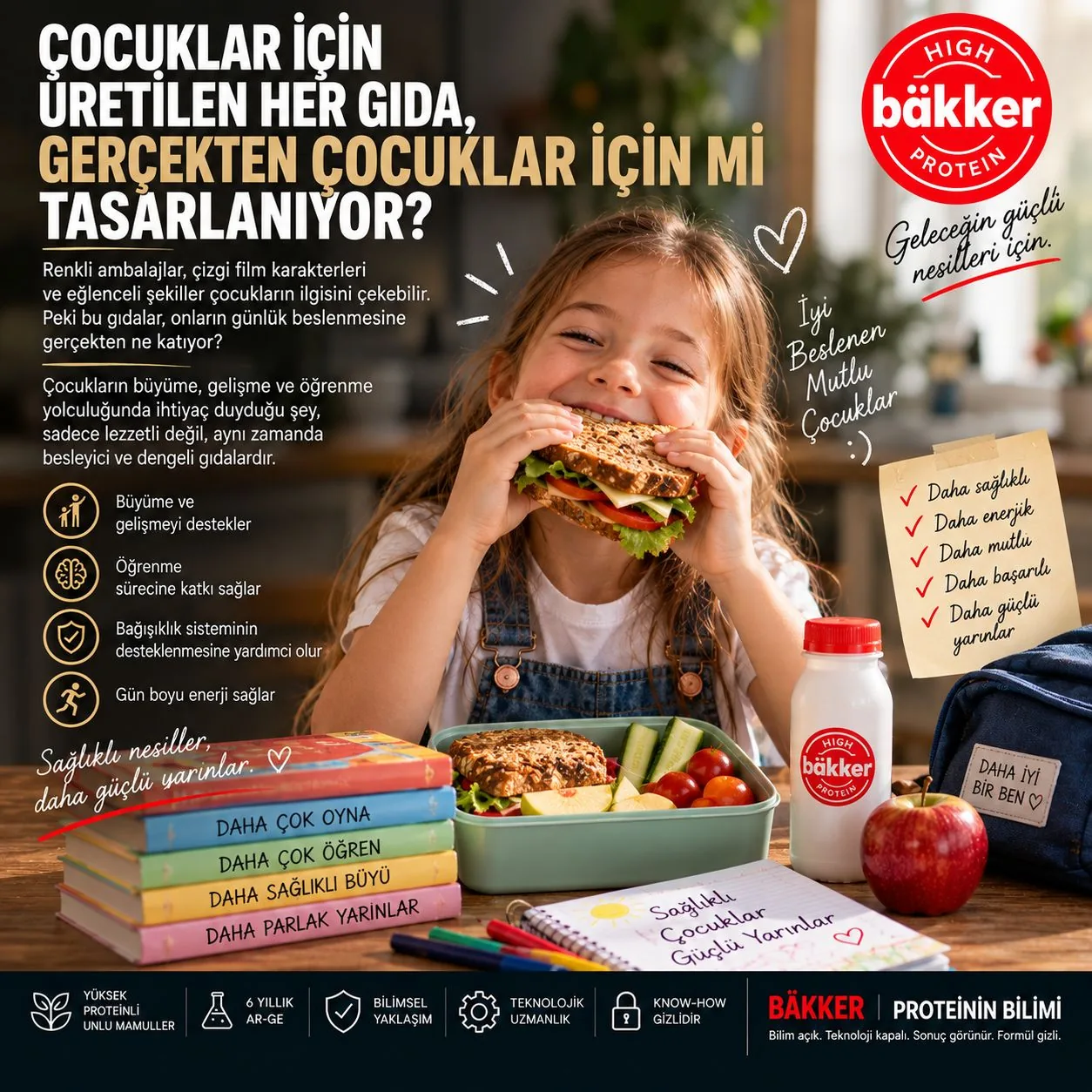
Is every food produced for children really designed for children?
- Putting a cartoon character on a package…
- Making the product smaller…
- Changing its color…
- Writing "child" on its package…
Is that enough to truly make a food aimed at children? I think this is one of the questions the food sector needs to discuss much more in the years ahead.
Because when designing a food aimed at children, it is not enough to ask only this question. Will the child like this? What does this product add to the child's daily nutrition?
Childhood is not only the years in which physical growth takes place.
Tissues renew, bone and muscle development continues, and the nervous system continues its development. Energy and various nutrients are needed for learning, movement, and daily life. That is why I find it incomplete for innovation in children's foods to move forward only through taste, color, shape, and packaging. Real innovation should perhaps begin on the side that cannot be seen.
✓ Nutrient density.
✓ Protein quality.
✓ Fiber.
✓ Vitamins and minerals.
✓ Portion structure, and all of these being able to be part of a balanced diet.
But there is a very important point here. More is not always better. Children's nutrition is not a scaled-down version of adult nutrition.
Requirements change with age, and adding as much protein, vitamin, or mineral as possible to a product does not automatically make it a better children's product. The point I insist on is exactly this: in a children's food, the goal should be more meaningful, not simply more.
For years the food sector has researched very well what children will like. Perhaps the next great transformation will be researching, with the same seriousness, what children need.
The future we are interested in at BÄKKER begins here too. Rethinking the baked goods consumed in daily life not only as products that fill you up, but from the standpoint of nutritional science.
How much of which ingredient will be used in a product aimed at children is a separate R&D subject that requires the age group, the portion, the overall dietary pattern, regulation, and scientific evaluation. But making a product into something children will like is marketing, while designing it with their nutrition in mind is responsibility.